Retirement report 2026: Away from the cliff edge
Foreword

It’s time to rethink retirement
We stand at a pivotal moment for the pension industry. In a changing landscape, we need to completely rethink how we approach retirement. And with this report illustrating that the word itself no longer resonates with large segments of the population, I’d argue it’s time to retire the idea of a traditional retirement entirely too.
Our report explores the forces reshaping work and later life, the implications for individuals, employers and society. And the changes we believe the pension industry - as well as employers and policymakers - need to make to adapt.
The conventional cliff-edge model of working continuously until you reach 65, then drawing down from a pension pot designed to last for a lifetime, no longer reflects the modern world. The way people live, work and age has fundamentally transformed, yet on the whole the pension industry’s approach remains rooted in the past.
“The conventional cliff-edge model of working continuously until you reach 65 no longer reflects the modern world.”
The population is aging. People are living longer, healthier lives. Their careers are more varied. And their expectations are changing. As this report shows, a large proportion of people actively want to continue to work past the traditional retirement age, but they want to work differently. They want more flexibility and more freedom.
Covid accelerated this transformation. It forced us to change the way we worked, and for some of us, particularly those based in offices, it illustrated that work does not have to be a binary choice between full-time employment and stopping altogether. Flexible approaches like hybrid working, sabbaticals and career breaks are creating new ways to combine work, income, leisure, caring responsibilities and family life. The rigid boundaries between employment and retirement are dissolving.
And the principle works for people in more physical jobs too. Keeping experienced workers on flexible terms, like shorter hours, or using their skills in different ways - for instance to mentor younger workers - not only improves personal well-being and health outcomes for those employees, but it also supports national productivity and plays a vital role in helping to close the savings gap.
So why has the pension industry been so slow to engage with these profound cultural and societal shifts?
The conversation has remained overwhelmingly focused on saving more and on making savings work harder. But closing the retirement savings gap is a three-part jigsaw. The third piece is the role that work plays in later life.
Our industry needs to move beyond products designed around a single moment of retirement and towards solutions designed around the realities of people's lives. Static monthly pension payouts fail to maximise returns and can cause tax burdens. We need to instead think about dynamic drawdown solutions that alert members if, for instance, they are withdrawing too fast. This combined with more personalisation and better guidance can help people make their money work with their changing circumstances.
“But closing the retirement savings gap is a three-part jigsaw. The third piece is the role that work plays in later life.”
We need to educate people so they can properly prepare for their future and retire with dignity – that includes helping them to understand benefits like pension credit which is currently underclaimed. As our report shows, a large percentage of the population currently don’t get any guidance at all.
There is a huge opportunity for the pension industry and stakeholders to design a system that reflects how people actually want to live. One that supports flexibility, mobility, changing priorities and longer lives.
This is not about suggesting that everyone should work longer. Nor is it about diminishing the importance of saving into pensions. It is about recognising that later life is becoming less of a destination and more about choices. It can mean many different things.
This is the start of the conversation. The first step in our journey towards defining and adapting our products and services for a more modern retirement. We’d love to know your thoughts.

Jamie Fiveash
CEO, Smart UK
About this report


Retirement today looks very different to a generation ago. Britain’s population is ageing. Almost one fifth of the population is over 65 and this percentage is set to rise*. On the whole, people are living longer, healthier and more productive lives.
At the same time, the age of the traditional ‘retirement age’ is over. Retirement is changing. People have more complicated choices, more opportunities but also more challenges. As our research shows, their expectations have transformed, and the pension industry, employers and policy makers need to catch up.
People used to follow a fairly predictable path. They stopped working at a set date based on their birthday, drew a regular pension income and entered a new phase of life. Nowadays people are no longer forced to retire at 65 and the age they can claim their State Pension has risen and looks set to rise again. Whether through choice or necessity, traditional views on when, and if, to stop work are changing fast.
This report examines the rapidly changing landscape of retirement. How do people in the UK now feel about their retirement years? And is the word retirement even relevant or useful today?
Methodology
To understand different perspectives across the UK, we commissioned a nationwide survey of 3,000 people. The size of the survey allowed us to focus on a broad range of people. It included a sub-sample of 816 respondents aged 50 to 65, who are approaching State Pension age/traditional retirement age. We wanted to learn how they feel about retirement, their expectations and their desires for the future. We also wanted to know how they access critical support to help them achieve the future they want.
The highlights

This is a complicated story, but also a positive one. The good news is that despite all the complexities, 58% of the people we surveyed view the idea of retirement positively, although experiences vary by income, gender and region.
But interestingly 44% of those surveyed and in particular 48% of women feel the word ‘retirement’ no longer describes their expectations for later life. And over a third would like to keep working in some way, preferring flexible or part-time roles.
Yet real obstacles remain, from tax hurdles – 32% of people say taxation and pension rules are a barrier – and rigid workplaces to a lack of credible advice. Despite access to Pensions Wise and other services, 42% of people say they would not seek help or guidance about their future.
This means there are a wealth of opportunities for pension providers, employers and policy-makers to support people and help them to look forward to a rewarding and fulfilling future.
Is it time to ‘retire’ retirement?

Our research explored how people feel about ‘retirement’ and how they want to talk about it. It showed that Britain is broadly positive about the prospect. But the way people expect to experience this period of life – and therefore the way they describe it – is changing to reflect a new and multifaceted reality that encompasses a broad range of choices and possibilities.
Most people are positive about retirement…
The results showed 58% of people view retirement as a positive milestone compared to 26% who view it negatively. However, there are clear differences across groups:

But almost half don’t think ‘retirement’ is the right word
When it comes to the word ‘retirement’ itself, public opinion is split. When asked ‘how well do you think the word retirement reflects what later life looks like for people today?’ 40% feel that the word still works well, but a larger proportion – 44% – disagree, with women notably less keen on the word.

What's the alternative?
We asked people to come up with their own suggestions to replace the word retirement and although there were a wide range of ideas, 21% (or 1 in 5) favoured ’freedom years’ closely followed by 18% who preferred ‘later life’. Although the older they were, the less they liked the latter term – just 12% of 65-74 year olds liked the term vs 21% of 18-29 year olds.
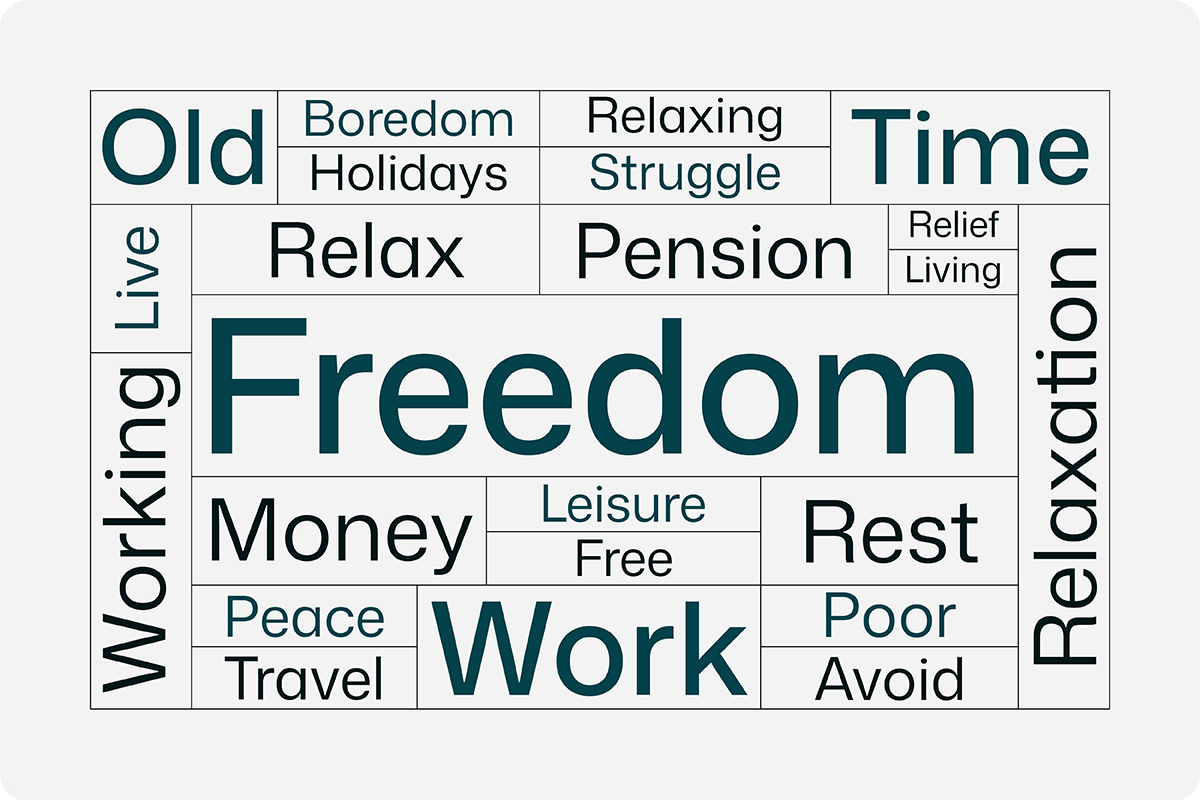
This all points to a nuanced reality. The word ‘retirement’ is trying to capture a broad variety of experiences and perspectives. But the variation is now so wide that for many people, the word itself is no longer an accurate or particularly helpful term for the reality of how they spend (or will spend) their later years. So we need to start thinking about this era of life completely differently.
People want to work for longer


The preconception that everyone wants to stop working once they reach a standard retirement age was sharply challenged by the data. Although there are still a large number of people who would prefer to stop working altogether, over a third of the population want to continue working in some form, and not just for financial reasons.
People have a strong appetite for remaining in a similar role to one they are currently in, but part-time. And also for changing careers, retraining or starting a new business.
Of those people who are keen to remain in paid work, only 11% of people want to stay in their current role full-time for as long as possible, and 50% say they would like to stay in their current role or similar with fewer hours, and 39% want to move into a different type of paid work.
Across all ages, flexible or part-time work is clearly the favoured option.
Interestingly, there is little significant gender variation. Men are marginally more positive about paid work in retirement, with 42% of men preferring paid work versus 39% of women.
Addressing the gap between people's desire to work longer, and today’s workplace reality, would make a significant contribution to the UK’s economic growth.

The older people are, the more they want to work for longer
In the 50 to 65 group, 45% say they would be interested in continuing to do ‘a version of my current role/my current work, but less of it’. This means almost half of people who are on the road to retirement would be interested in continuing to do some variation of their current work on a part-time or reduced hours basis after the traditional retirement age. A quarter of the 50-65 age group say they would be interested in moving into a new role or industry they have not worked in before.
It’s not just a financial decision
While for many, money is going to be a driving motivation in their desire to continue working, this isn't just about financial gain. When thinking about stopping work, 19% of people worry about losing a sense of purpose or getting bored, 19% about staying mentally sharp and 15% about feeling isolated. This may explain why around half of the population is keen to volunteer.

This goes to show that many people feel that later-life work, paid or unpaid, will provide them with purpose, social connection and mental stimulation. And increasing evidence shows that working can improve physical health and wellbeing too**.
A note on care
Across all ages, people expect to spend more time caring for family members in later life with little significant variation in responses between the genders.

With an ageing population, the need to factor in care for others will grow. As with other aspects of retirement, the picture is complicated. There is no single model of being a carer in later life and in most cases there are positives and negatives for people who care. We can surmise however that employers who offer flexibility and reduced hours will make working more viable for people with caring responsibilities.
Making the most of this new reality


This willingness of older people to continue working for longer offers a huge opportunity for employers and the government.
As the population ages and the birthrate falls – making younger workers more scarce – there’s a strong business case for employers to do more to retain their existing employees.
The government benefits too. These older employees continue to make tax contributions, widening the tax base and improving the dependency ratio.
And if, as some research implies, the right kind of post retirement work could help more older people to lead happier and healthier lives**, then there are implications for reducing the burden on the NHS and social care services too.
But to make work work for older people, we need to remove the practical obstacles.
For employers – offering flexibility is key
Offering flexibility is the single most effective change employers could make to support people who want to work for longer.
Most people don't want more years of conventional full-time employment. They want different ways of working. 48% of people say flexible or reduced hours would help them to continue in their role. However there are disparities within socio-economic groups. 51% of people in professional or managerial roles are keen on the idea of flexible and part-time working but this drops to 37% for people in lower paid/more manual roles. And it should be noted that 35% of people could not be incentivised to keep working.
Ageism plays a part
There is a cultural aspect too, with 25% of 50 – 65 year olds saying that they might not continue to work because they are concerned that “employers would not hire me because of my age”. Combating ageism or the perception of ageism may help a quarter of this age group to feel more positive about staying in work.
For Government – there are opportunities too
The government has a role in supporting the new reality of later life. For 32% of people, taxation and pension rules are a barrier to working for longer.
Current rules mean that you have to stop making pension contributions once you reach 75 and the amounts you can contribute may be limited if you have already started taking flexible income from your pension.
Unsurprisingly, rules around pension contributions are much more important to people with more disposable income. 29% of managerial/professional respondents say ongoing pension contributions would encourage them to go on working, while only 18% of lower paid respondents say the same.
Women are also more interested in continuing to make pension contributions, possibly because of the gender pension gap and fewer savings as a result. 28% of women say this would encourage them to work versus 25% of men.
If policymakers did more to incentivise and support people to stay in employment it could have significant fiscal benefits and potentially boost productivity by keeping high-skilled workers active.
This isn’t about making people work for longer. It’s about supporting the large numbers who would like to choose to do so.
For pension providers – it’s about agility
As well as the other changes we’ve outlined, the UK is rapidly shifting from a defined benefit to a defined contribution pension system based on individual pots. This puts much more onus on employees to make the decisions that affect their future - something that most people are ill-equipped to be able to do (see the Information Gap chapter).
For pension providers, the ability to adapt quickly to the demands of this rapidly evolving retirement landscape – from changing employer and member expectations to new legislation – is key.
We need to think about how we can maximise returns and reduce tax burden with dynamic drawdown solutions, personalisation and better guidance.
For employers and their employees, we need to offer seamless customer service. People want their pension to be as simple to access as mobile banking and online shopping. They expect to be able to understand and manage their pension savings easily in apps or online and to be able to make simple changes quickly at a time that suits them. But, as decisions around pensions are often complicated, they also want to be able to get help from a human when they need to.
Pension providers need to offer all this, while incorporating new pension and tax regulations quickly and efficiently, preventing fraud and providing strong returns on investment. The ability to be agile is essential, and digital technologies and AI are key to making this happen.
Read about how Smart Pension is using technology to provide customer service that is faster, simpler and more human.
The information gap


As decisions get more complicated, it’s becoming even more important that people are fully equipped to understand options that can have huge consequences.
But in our research we found that many people do not get – or do not want – help and advice from others. More than 4 in 10 people said they would make choices about later life without seeking guidance from anyone else.
Only relatively small numbers of people would go to official sources or the pensions sector for support, turning to friends, family and colleagues instead. Social media and AI also play a role for some.

Interestingly, 10% of 50–65 year olds use AI tools for guidance – the same amount as who would talk to their pension providers.
The fact there is no single popular source of information suggests that there is a large gap that needs to be filled.
A lot of people are making choices that could shape the rest of their lives without any expert help or guidance. FCA research shows that this can lead to poor decisions which is a key reason the government is reforming the system and introducing new Guided Retirement Products. As a result, pension providers, employers and the government should work together on improving education.
Conclusion and recommendations

Our analysis shows that the reality of later life is increasingly about complicated choices and trade-offs. Today’s retirement is far more individual.
All-or-nothing views of retirement are a thing of the past. We should be helping people to transition smoothly into later life through varied paths, including meaningful work that promotes mental and financial wellbeing while benefiting the wider economy.
From our research, there are striking arguments for actions we can take to empower people to make positive choices about their future.

Retirement is now as individual as we all are
Some people want to continue working as long as possible. Others dream of retiring early to travel or spend more time with family. Some are dealing with health issues or caring responsibilities. Many move in and out of work – through financial necessity – or as our research shows, because they want to. With no set retirement age and no standard retirement template, there’s no single right moment to start spending pension funds.
Later life involves a careful balance between work, finances, and personal priorities. Planning for long-term income in a personal-pension world is complicated and helping people work longer brings practical challenges.
But there are also potentially many social and economic opportunities. This report shows we need to listen closely to people’s everyday experiences. By listening we can help shape better workplaces as well as pension policies, products and support systems that are fit for the present and the future.
Read more
Find out how Smart Pension is rethinking retirement with our reinspirement campaign.